No one moved when the senior officer stopped three paces in front of her.
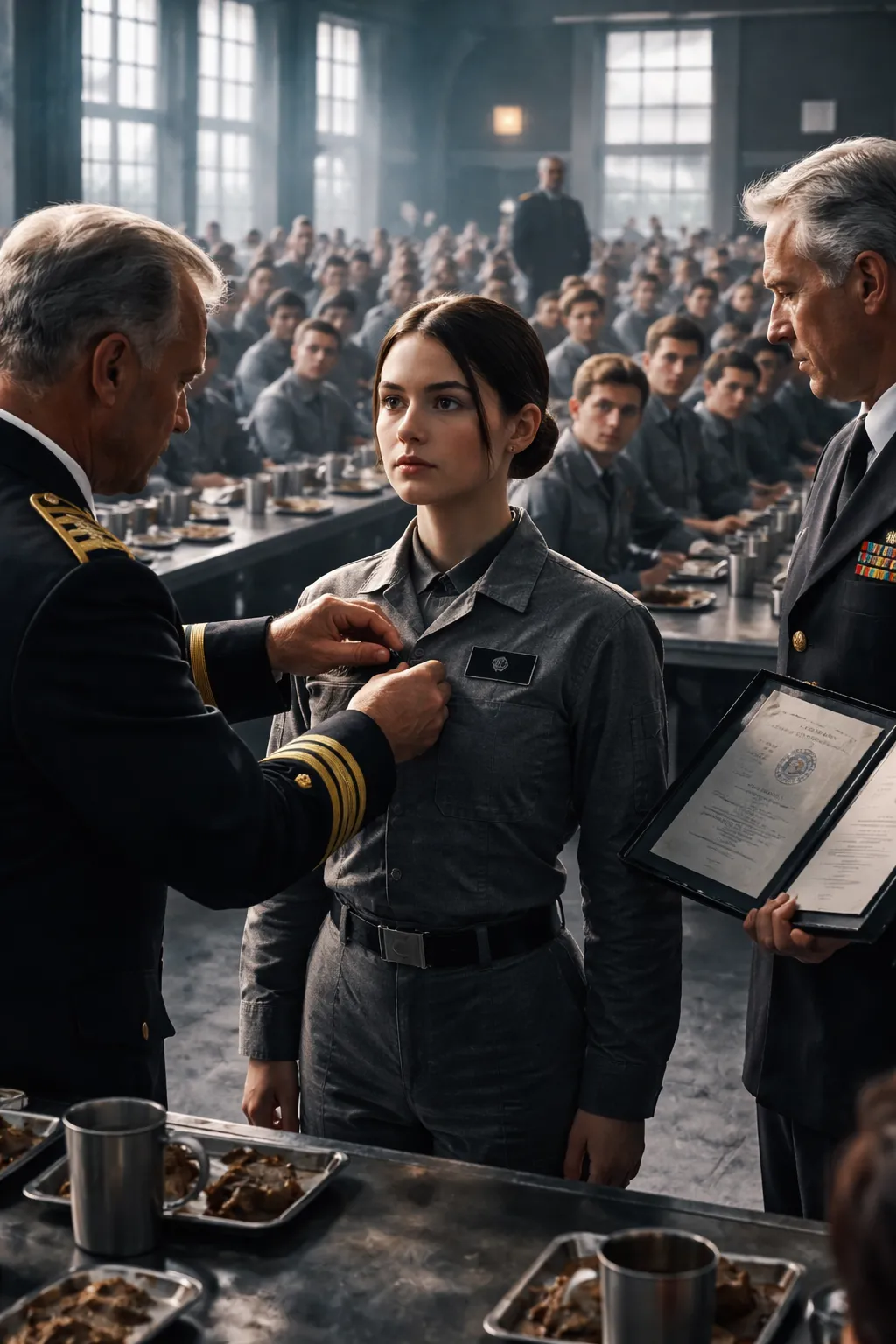
The Atlantic wind could be heard faintly through the mess hall’s high windows, rattling the glass like distant artillery. Two hundred cadets sat frozen behind steel trays and unfinished meals.
“Cadet Natalie Brooks,” the officer said evenly, “front and center.”
Natalie stepped forward.
Not quickly. Not slowly.
Precisely.
Her boots struck the floor in controlled rhythm, and for the first time since arriving at Graystone, every eye in the room followed her without dismissal.
The academy instructor who had been correcting her cleared his throat. “Sir, if this concerns her recent performance evaluations, I can assure you—”
“It does not,” the officer replied.
The words were not loud. They didn’t need to be.
A second officer—silver-haired, posture unbending—placed a slim black case on the nearest table. The metal latches snapped open with a sound that carried farther than the earlier laughter.
Inside lay a new shoulder patch. Dark navy. Embroidered insignia none of the cadets recognized.
And a folded document bearing a federal seal.
The senior officer turned slightly, addressing not just Natalie—but the room.
“Effective immediately, Cadet Brooks’ training status at Graystone Naval Tactical Academy is concluded.”
A ripple of confusion broke through the hall.
Concluded?
She hadn’t passed top tier evaluations. She hadn’t won command trials. She hadn’t—
“She has fulfilled the parameters assigned to her,” the officer continued. “Every parameter.”
The instructor’s face drained of color. “Assigned by whom, sir?”
A pause.
“By us.”
The second officer removed a small rectangular pin from the case. Matte finish. Minimal design. The kind worn by personnel whose roles were rarely spoken of in public briefings.
“You were told to remain in the bottom performance tier,” he said quietly to Natalie. “To avoid leadership selection. To limit peer visibility. To simulate plateau.”
“Yes, sir,” she answered.
Her voice carried clearly now. Not strained. Not defensive.
Calm.
“You were instructed to miscalculate within acceptable margins during three tactical simulations to measure internal data leaks.”
“Yes, sir.”
A visible shift moved through the hall. Cadets exchanged glances that no longer held humor.
“You were directed to reduce your marksmanship scores by no more than seven percent to prevent algorithmic flagging.”
“Yes, sir.”
The senior officer faced the room again.

“For the past 127 days, Cadet Brooks has been operating under federal directive as part of an internal security assessment. Graystone was not aware of the full scope.”
The words landed harder than any shouted reprimand ever had.
Internal security assessment.
The instructor swallowed. “Assessment of what, sir?”
The silver-haired officer’s gaze sharpened.
“Of vulnerability.”
Silence.
“Over the past year, multiple tactical institutions have experienced data breaches during live training cycles. Strategy adjustments made during simulation were appearing in external classified channels within hours. We traced the pattern to mid-tier cadet performance clusters.”
A few cadets stiffened.
“Not the top scorers,” he continued. “Not the lowest. The middle. The ones no one watched closely.”
The implication spread like frost.
Natalie had not been hiding incompetence.
She had been bait.
The officer stepped closer to her. “Your restraint maintained operational integrity. Your discipline prevented premature exposure. And your silence protected an investigation that concluded this morning.”
He turned toward the academy command staff now gathering at the entrance.
“The breach has been identified.”
A chair scraped somewhere near the back.
No names were spoken.
None were needed.
The black pin was fastened to Natalie’s uniform with deliberate care. It caught the overhead lights for only a second before settling into muted anonymity.
No flourish. No applause.
Just recognition.
“You will report to Washington within forty-eight hours,” the officer said. “Your next assignment will not permit simulated mediocrity.”
“Yes, sir.”
For the first time since arriving at Graystone, a subtle change registered in her posture. Not pride.
Release.
The senior officer gave a final nod. “Dismissed, Cadet Brooks.”
Protocol dictated she salute.
She did.
But when she turned, something unexpected happened.
The path back through the mess hall did not part out of dismissal.
It parted out of respect.
No one laughed.
No one whispered.
A cadet who had once muttered “barely holding on” lowered his eyes as she passed.
Another straightened instinctively.
At the far end of the hall, the Atlantic wind howled again, slamming against the glass as if demanding acknowledgment.
Natalie paused at the doorway only once.
Not to look back at the smirks that had faded.
Not to search for validation.
But to take in the room as it truly was—seven hundred trainees learning that strength did not always announce itself.
Sometimes it endured quietly.
Sometimes it absorbed doubt like armor.
Sometimes it accepted humiliation as operational necessity.
For 127 days, she had allowed them to measure her by a board.
Now they understood something far more difficult:
The most dangerous presence in any formation is the one that does not need to prove itself.
The doors closed behind her.
And for the first time since she arrived at Graystone Naval Tactical Academy, Cadet Natalie Brooks walked into the wind without pretending to struggle against it.