The glare from Linda’s house, the subtle disapproval from my husband, and my MIL’s thinly veiled criticisms all converged, creating a heavy cloud of doubt over my decision. I had stood my ground, defending my property against a persistent boundary-crosser, but the fallout was messier than I’d anticipated. Linda’s fury and her rapid neighborhood campaign against me left me wondering if, despite my repeated warnings, I was the asshole for resorting to a tow truck.
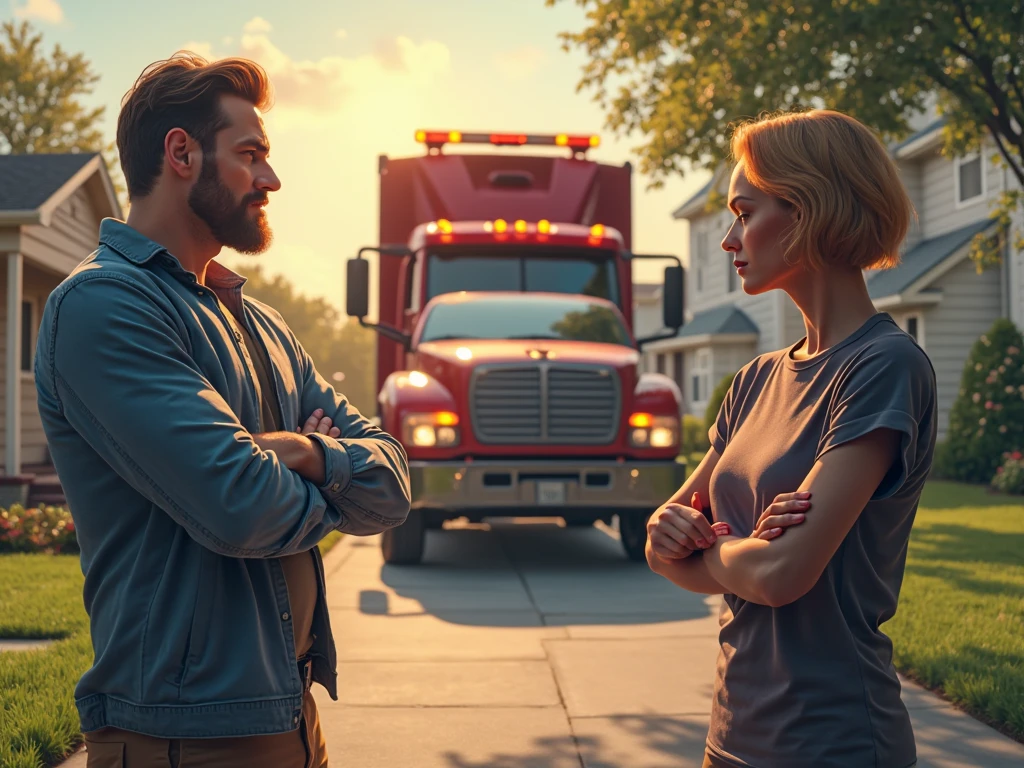
The suburban peace had been irrevocably shattered. Linda’s glares were a constant presence, her whispered accusations to other neighbors occasionally reaching my ears. My husband, while outwardly supportive, continued to express his discomfort with the “drama,” and my MIL’s barbed comments felt like tiny cuts. I had expected a clean victory, a clear assertion of boundaries. Instead, I was embroiled in a neighborhood feud, feeling like the villain despite believing my actions were entirely justified. The nagging question of whether I’d truly gone too far lingered, amplified by the pervasive sense of disapproval.
A few days later, a local newspaper delivery person, a friendly older woman named Martha who had lived in the neighborhood for decades, knocked on my door. She often stopped to chat. This time, her expression was somber.
“Linda’s having a rough time,” Martha said, her voice gentle. “I just wanted to share something with you, not to excuse anything, but maybe to help you understand.”
I invited her in, intrigued despite myself.
“You know Linda’s husband, Jim, passed away about a year and a half ago, right?” Martha began. “He was a good man, salt of the earth. Always meticulous about his cars, his driveway, everything. He worked at the local auto shop for forty years, loved cars more than anything. Their garage was practically a museum.”
I nodded. I knew Jim had passed, but hadn’t known the details.
“When Jim died,” Martha continued, her voice heavy, “Linda completely fell apart. He handled everything. The bills, the house, the cars. She was always… a bit overwhelmed by practical things. And Jim always insisted on parking his car in the left side of the double driveway, and her car in the right. It was their routine, their little unspoken rule. He’d even get annoyed if she parked on his side, even for a minute.”
My mind flashed back to Linda’s car, always parked in my driveway, often on the side closest to her house, which would have been her side if she had a double driveway.
“After Jim passed,” Martha said, “Linda couldn’t bring herself to drive his car. It just sat there in the driveway, in his spot, gathering dust. She started using her own car less and less, finding excuses to walk or get rides. She even stopped parking it in the driveway sometimes, leaving it on the street, which was unusual for her. Then, about six months ago, his car finally broke down completely. Cost too much to fix. She had to let it go.”
A sudden, chilling thought struck me. Six months ago. The same time Linda’s parking in my driveway had started.
“You see,” Martha explained, her eyes filled with a quiet sadness, “when Jim’s car was gone, her own car became too much. It was supposed to go in her spot, but his spot was empty. And the whole driveway just… it felt wrong to her. It felt empty, like a huge gaping hole where Jim used to be. It was too painful to see her car, alone, in her spot, with his spot empty beside it. It was a constant reminder that he was gone, and that she was alone.”
Martha paused, then looked directly at me. “So, she started parking her car in your driveway. Not because she’s malicious, not because she’s trying to annoy you. But because your driveway is a double driveway, and it’s always full. It’s always occupied. It’s always… normal. Like her life used to be, when Jim was there, and both sides of her own driveway were full. It’s her way of subconsciously recreating a sense of normalcy, a sense of having a ‘full’ life, even if it’s just a projection onto someone else’s space. She’s not trying to steal your parking; she’s trying to escape the unbearable emptiness of her own.”
She concluded, “When you towed her car, you didn’t just move a vehicle. You removed her silent, desperate coping mechanism. You forced her to confront the very emptiness she’s been trying to avoid, the very grief she’s been trying to camouflage by borrowing a piece of normalcy from your life. Her fury wasn’t about the money, or the inconvenience. It was about the sudden, brutal reminder of what she had lost, and the complete unraveling of her fragile attempt to pretend, just for a moment, that her life was still full.”
The air in my living room felt heavy, not with anger, but with profound, aching understanding. The “petty” neighbor, the “vindictive control freak” – she wasn’t that at all. She was a deeply grieving woman, unknowingly replaying a poignant ritual, clinging to a tangible symbol of a lost partnership. Her consistent parking in my driveway wasn’t a boundary violation; it was a desperate, almost unconscious, attempt to fill the gaping void left by her late husband, to find solace in the mirrored normalcy of a full, shared driveway. My decisive action, while justified on the surface, had inadvertently ripped away a fragile coping mechanism, forcing her to confront the very grief she was so desperately trying to outrun. The AITA question, once a clear binary of right and wrong, dissolved into a profound, aching understanding of the unseen burdens people carry, and how the echoes of devastating personal loss can tragically dictate adult actions, even at the cost of profound, yet ultimately illuminating, conflict.