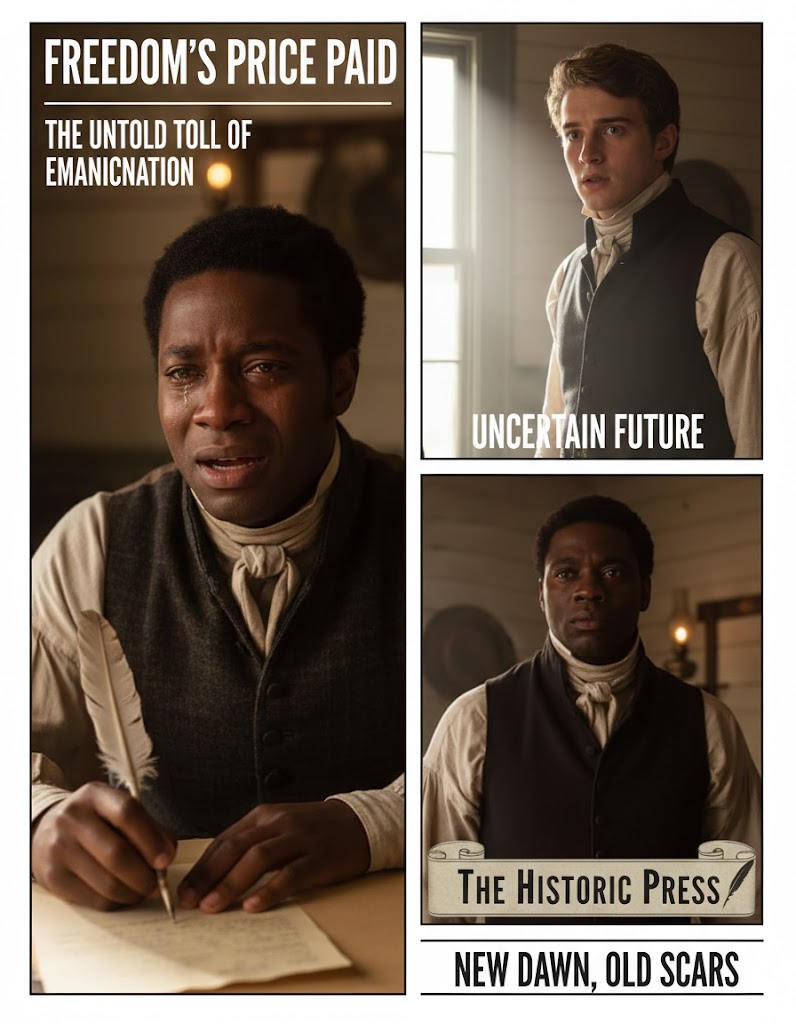
The first night in the trader’s pen taught Caleb the true weight of almost-freedom. It was heavier than chains because it had shape. It had edges. The room was narrow, timbered with old pine that smelled of rot and iron. A single barred window cut a thin blade of moonlight across the dirt floor. Caleb sat with his back against the wall, wrists raw, legs cramped, the folded paper hidden inside the seam Thomas had torn and resewn with shaking hands. He did not sleep. He counted breaths. He rehearsed words he might need. Words, he had learned, were currency here—sometimes worth more than flesh.
Morning came with noise. Keys. Boots. A man with spectacles and a ledger tucked under his arm stopped at the bars and studied Caleb like a line item that refused to balance. “Name?” the man asked. Caleb hesitated just long enough to choose truth without surrender. “Caleb,” he said. The man nodded, as if names were optional accessories. “Skill?” “Writing.” A pause. The pen scratched the ledger. Ink again deciding where the body would go.
They marched him to a table beneath an awning. Buyers gathered. Hands pried mouths open, pinched muscle, weighed silence. When his turn came, Caleb stood straight. He met eyes. He did not beg. When asked again, he said it clearly, carefully.
“I can write. I can read contracts. I can keep accounts.” Some laughed. One man did not. The man with spectacles—Mr. Hale, the ledger said—raised a hand. The price settled lower than a strong back, higher than a broken one. Caleb felt the balance shift and lock.
Hale’s place was smaller than a plantation, leaner, meaner in its efficiency. A warehouse by the river, boats coming and going like thoughts no one finished. Hale did not whip. He docked. He did not shout. He corrected. He set Caleb at a desk by a window and tested him with columns that bled numbers.
Caleb steadied his breath and wrote. He corrected errors Hale had missed. The silence that followed was the loudest sound in the room. Hale adjusted his spectacles. “You’ll keep the books,” he said. “You’ll sleep where I can find you.” Caleb nodded. Survival was a grammar he knew.
Weeks turned into months. Ink thickened under his nails. His back healed. His mind sharpened. Hale trusted him with letters, then with ledgers that told stories money did not want told. Caleb learned routes, debts, names that recurred like bad dreams. He learned which boats never returned. He learned how paper could erase a man without spilling blood. And he learned restraint. He did not steal. He did not alter. Not yet. He stored knowledge the way others stored grain.
At night, when the river went quiet, he unfolded Thomas’s paper and read it until the creases softened. It was nothing extraordinary. A list of dates. A sentence half-finished. Proof of a boy choosing to fracture his inheritance rather than inherit a fracture. Caleb traced the ink with his finger and felt a steadiness settle in his chest. Almost-freedom again. A shape. Edges.
Hale tested him one evening with a sealed envelope. “Read,” Hale said. Caleb read. The letter spoke of shipments miscounted, margins shaved, suspicion coiled tight. Hale watched Caleb’s face for betrayal. Caleb gave him accuracy. Hale nodded. “Write my reply.” Caleb wrote the truth in a way that would survive being believed. When Hale sealed it, he did not look away. Trust, Caleb learned, was built from exposure controlled.
The river brought a woman named Ruth. She arrived with a bundle of clothes and a ledger of her own, sent by a partner who had died too suddenly to explain himself. Hale frowned at her numbers. Caleb read them once and felt the hair lift on his arms. The pattern was there—clean on top, rotten underneath.
Ruth watched him read. “You see it,” she said softly. Caleb nodded. “Then say nothing,” she whispered. “Yet.” They began to work after hours, numbers moving between them like contraband. Ruth had a laugh that startled the room when it escaped. Caleb learned to listen for it.
Pressure returned the way it always did. A creditor came upriver with a smile too practiced. Hale’s jaw tightened. He handed Caleb a ledger. “Find me air,” he said. Caleb did. He found time where there was none, truth arranged so it would not be punished. He bought weeks. He learned that delay could be mercy.
But delay had a cost. The warehouse changed. Locks doubled. Hale slept less. One night, a boy ran for the river and did not surface. The next morning, Hale did not ask where he had gone. Caleb wrote the inventory as if nothing had shifted. Ink was faithful. Ink did not ask forgiveness.
Ruth came to him with a decision carved into her voice. “We can break this,” she said. “Not by burning it. By writing it.” She slid a page toward him—routes, names, dates. Evidence that wanted to be born. Caleb felt the old terror bloom. Exposure meant fire. Exposure meant chains.
He thought of the master’s trembling hands, of Thomas’s paper hidden in cloth. He thought of the river swallowing boys without a ripple. He closed his eyes. “Who will read it?” he asked. Ruth named a place upriver where papers mattered. Where words could bite.
They worked for three nights. Caleb wrote until his wrist burned. He chose clarity over drama. He chose facts sharp enough to cut without bleeding him dry. When it was done, Ruth wrapped the pages in oilcloth. “I’ll take it,” she said. Caleb shook his head. “I will.” He knew the risk calculus. He knew who would be missed.
The dawn they chose was gray and patient. Hale was asleep. The river breathed. Caleb slipped the packet into his shirt and walked as if walking were allowed. At the bend, he did not run. He stepped into a skiff and pushed off. Oars dipped. The current caught him like a hand deciding to help. A shout followed. Then another. The skiff rocked. A shot cracked and stitched water. Caleb rowed until his lungs tore, until the warehouse became a thought he could put down.
Upstream, the place Ruth named was smaller than legend and louder than fear. A man took the packet and did not smile. He read. He read again. “Stay,” he said. Caleb stayed. He wrote names on clean paper until they stopped shaking. He slept on a bench and dreamed of ledgers that refused to close.
The reckoning did not arrive like thunder. It arrived like mail. Boats stopped. Locks changed hands. Hale vanished into a ledger he could not correct. Ruth’s laugh returned, quieter now, earned. Caleb watched men learn the weight of paper when it landed.
Freedom did not. Not yet. But the world tilted. And in that tilt, Caleb found a narrow place to stand. He wrote for wages paid to a name he had chosen and practiced signing until the ink felt honest. He sent one letter south, careful, untraceable. He did not know if Thomas would read it. He knew only that he had written it as if it mattered.
Years later, when the river ran high and the warehouse was only a memory men pretended not to have, Caleb would teach a boy to hold a pen without fear. He would say nothing grand. He would show the pressure. He would correct gently. He would tell him this one thing and no more: write so the truth survives being believed.
The first rule of the new place was restraint.
Caleb learned it quickly. Freedom-adjacent spaces had their own laws, quieter and more dangerous than plantations. Here, a man could walk without chains and still be owned by a look, a ledger, a rumor that traveled faster than truth. Caleb kept his head down. He wrote. He listened. He did not let hope announce itself.
The office sat above a cooper’s shop near the river bend, the air forever sweet with sap and damp wood. Papers lived everywhere—on desks, on shelves, pinned to walls like skins curing in the dark. The men who came and went spoke in half-sentences.
Names were abbreviated. Dates mattered more than faces. Caleb became a hand that moved without drawing attention, a mind that remembered without boasting. He learned to survive among those who survived by never being named.
The letter he had sent south returned months later, folded thin by distance. The seal was unfamiliar. The handwriting was not Thomas’s. Caleb’s chest tightened before he read a word. The letter was brief. Thomas had left. There had been a quarrel.
A father’s silence. A son’s refusal to inherit blood as interest. The letter ended with a line that felt like a benediction: Your words reached him, even if he never answers.
Caleb pressed the paper to his mouth and breathed.
Work multiplied. The packet he had carried upriver had not ended a world, but it had cracked one. More pages followed. More routes were mapped. Men learned that paper could be a net as much as a shield. Caleb wrote affidavits that never used his name. He copied testimonies taken in kitchens and barns, words whispered as if God himself might be listening. He learned to remove himself from sentences so the sentences could live.
But there were nights when ink felt like a betrayal. When he saw the boy in the river again. When the sound of a shot stitched water in his sleep. On those nights, Ruth would sit across from him at the table and say nothing. She had learned, as he had, that silence could be a hand on the shoulder.
It was Ruth who noticed first when men began to look at Caleb differently. Not as a tool, but as a solution. A dangerous shift. “Careful,” she warned one evening, low. “They’ll want you to sign.”
“I won’t,” Caleb said.
“They’ll try anyway.”
They did. A man with clean cuffs and careful shoes came one morning and praised Caleb’s clarity, his precision, his reliability. He slid a paper across the desk. A name waited at the bottom, blank and patient. “Just accountability,” the man said. “So the right people know who to thank.”
Caleb pushed the paper back. “The work doesn’t need my name,” he said.
The man smiled thinly. “Everything needs a name.”
Caleb met his eyes. “Not this.”
The man left. The air changed.
Threats did not arrive with violence. They arrived as scarcity. Work slowed. Pay thinned. Access narrowed. Doors closed that had never been open. Ruth watched it happen and cursed softly. “They want you visible or gone,” she said.
Caleb nodded. He had lived this grammar before.
He found the boy in the cooper’s shop the same afternoon. Twelve, maybe thirteen. Quick hands. Curious eyes. He had been watching Caleb write through the floor slats. When Caleb looked up, the boy did not look away. “How you make it straight?” the boy asked, pointing at the lines.
“You practice,” Caleb said.
“With what?”
“With whatever you can afford to lose.”
He brought the boy scrap paper. Charcoal. A broken pen mended with twine. He taught pressure before letters. He taught patience before pride. He taught how to hide learning inside labor so it would not be punished. The boy learned fast. Too fast. It scared Caleb the way all gifts did.
The reckoning returned not with a knock but with a fire. One night the cooper’s shop burned. Buckets came too late. The upper rooms filled with smoke. Papers screamed as they curled. Caleb dragged boxes into the street until his hands blistered. When the fire died, the damage counted itself. Ledgers gone. Names erased. Testimonies turned to ash.
“It was meant,” Ruth said, eyes red.
Caleb knew. He tasted intent in the smoke.
They rebuilt smaller. Quieter. They hid duplicates where damp could not reach. Caleb learned the art of dispersal—how to break truth into pieces small enough to survive capture. He sent copies in different hands, on different days, so no single loss could be total. He learned to let go of outcomes. To trust process.
The boy returned, soot-smudged and shaking. “They burned the words,” he said.
“They burned paper,” Caleb replied. “Words live longer.”
Winter tightened the river. Ice taught patience. During that winter, Caleb signed his name for the first time in a public ledger. It was a risk measured to the breath. He chose a place where the name would be ordinary. He chose a spelling that could pass without echo. When the ink dried, he felt a grief he had not expected. Names were anchors. Anchors held you where storms could find you. Still, he did not regret it. A man without a name could be erased too easily.
Spring brought news like a bruise blooming. Hale had been seen, older, smaller, working under a different ledger. The world had not swallowed him. It had reduced him. Caleb felt no triumph. Only a tired justice that did not sing.
Thomas never came. But a parcel did. Inside: a book with a cracked spine, margins crowded with a young man’s notes. On the inside cover, a line in familiar hand: For when you need proof that words can change the shape of a life.
Caleb closed his eyes and let the ache be clean.
Years passed. Laws shifted like weather. Men argued. Guns spoke. Papers multiplied. Caleb stayed at his desk through it all, a fixed point in a turning room. He wrote until his hair grayed. He taught until his voice softened. He watched boys become men who could read their own contracts and women who would not sign what they did not understand. He learned to accept small victories without apology.
On a late afternoon, the river low and honest, the boy—now a man—brought him a page. “I wrote this,” he said.
Caleb read. The hand was steady. The truth was clear. The name at the bottom was his own. Caleb nodded once. “It will survive,” he said.
The man smiled. Not wide. Earned.
That night, Caleb cleaned his pen carefully. He folded his papers. He placed Thomas’s letter and the book together at the bottom of a drawer. He did not know what history would do with his work. He knew only what it had done with him. It had given him a way to stand without shouting. A way to fight without blood. A way to leave marks that fire could not fully claim.
Ink dried. The river moved. And somewhere, in a place that could not be named without risk, a man wrote his life forward, one deliberate line at a time.
Age arrived without ceremony. It came as stiffness in the fingers before dawn, as a longer pause before the first word found its place. Caleb adjusted. He always had. He switched pens. He warmed his hands over tea. He learned to trust the first sentence less and the second more. Precision, he knew now, was mercy applied patiently.
The city changed around him. Streets widened. Names on doors shifted. Men who once whispered now argued in daylight. Papers grew bolder, then crueler, then afraid again. Caleb watched the cycles repeat and understood that progress was not a straight line but a tide with a memory. He kept working. He kept teaching. He refused invitations to speak. He refused titles. Visibility, he had learned, was a debt that compounded.
One morning, a woman arrived with a bruise she would not name and a document she could not read. Caleb took the paper and felt the old anger rise, familiar and useful. The language was careful, the kind that smiled while it cut. He translated without ornament. The woman listened, jaw set. When he finished, she asked one question. “What happens if I don’t sign?” Caleb answered honestly. “They’ll try again.” She folded the paper. “Then they’ll try,” she said, and left with her shoulders squared. Caleb watched her go and felt the quiet satisfaction of a lever used well.
The man who had once been the boy returned often now. He brought others. Dockworkers. Seamstresses. Farmers with hands cracked open by weather and hope. Caleb did not preach. He read. He explained. He corrected. He taught them to ask one question before every signature: Who benefits if I do not understand this? The room filled with the sound of pages turning, the soft thunder of learning.
Threats returned, subtler this time. A note slipped under the door. A warning dressed as advice. Caleb burned it without reading. Fear was contagious. He would not let it breed. He changed routines. He stored copies where damp and flame could not agree. He trained two others to do his work in his absence. Redundancy, he told them, was a kind of love.
Ruth fell ill that winter. The laughter thinned, then stopped. Caleb sat by her bed and read aloud from the book Thomas had sent, the margins crowded with earnest argument. Ruth listened with her eyes closed, smiling at the stubbornness of youth preserved in ink. “Don’t let them put your name on a building,” she whispered once. Caleb smiled back. “I won’t let them put it on anything that can burn.” She squeezed his hand and slept. She did not wake.
Grief rearranged the room. Caleb moved slower for a while. He wrote shorter sentences. He allowed himself silence without guilt. When he returned to the desk, he found the work waiting, patient as ever. He took comfort in that. Work, unlike people, could be trusted to remain itself.
The city erupted one summer afternoon. Shouting. Running. Glass. Caleb locked the drawers and stood in the doorway, watching history rush past like a flood that refused to ask permission. He did not join the shouting. He noted faces. He memorized routes. When the noise receded, he opened the drawers and kept going. He wrote affidavits for the broken. He documented the missing. He wrote so there would be something to argue with later besides memory.
Late that year, a young clerk arrived with a proposition wrapped in flattery. A publication. A byline. “People should know who you are,” the clerk said. Caleb looked at the clean cuffs, the eager eyes. He thought of the master’s trembling hands. Of Hale’s ledger. Of the fire. “People should know what the words say,” he replied. The clerk persisted. Caleb ended the conversation gently and completely.
Time did what time does. Caleb’s hands steadied into a slower grace. His sight dimmed; his listening sharpened. He delegated more. He taught more. He learned to let others lead without correcting their every misstep. Control, he discovered, was another kind of chain.
On an ordinary evening, with the river low and honest again, the man who had been the boy brought him a bundle tied with twine. Inside were copies—many copies—of documents Caleb had written years ago, now cited, referenced, argued over by people who would never know his name. “They’re using it,” the man said, awe and fear tangled together. Caleb nodded. “Then it worked,” he said.
He went home and opened the drawer one last time. Thomas’s letter. The book. He placed them side by side and wrote a note, brief and careful, for whoever would clean the room after he was gone. These mattered to me. Keep them if you keep nothing else. He folded it neatly. He closed the drawer.
That night, Caleb dreamed of a desk by a window and a river that moved without hurry. He dreamed of a pen that never ran dry. When morning came, he rose, dressed, and walked to the office. He sat. He wrote one paragraph, then another. He signed nothing. He left the desk tidy.
When they found him later, the ink on the page was still wet. The sentence ended mid-line, unfinished not from fear or force but from time claiming its due. The work did not stop. It never does. Others took the pen. Others wrote. The words went on without him, which was the point all along.
Ink dries. Paper burns. Truth, when written carefully enough, learns to travel light.