The sting of Matt’s accusation, his mother’s sarcastic “apology,” and the ensuing silence from his end left me reeling. I had been publicly humiliated, reduced to a prop at his own birthday dinner, and then told I “overreacted.” My dramatic exit, a desperate act of self-preservation, now felt shrouded in doubt. Was I the asshole for prioritizing my dignity over his birthday celebration, or was this a necessary stand against a toxic dynamic?
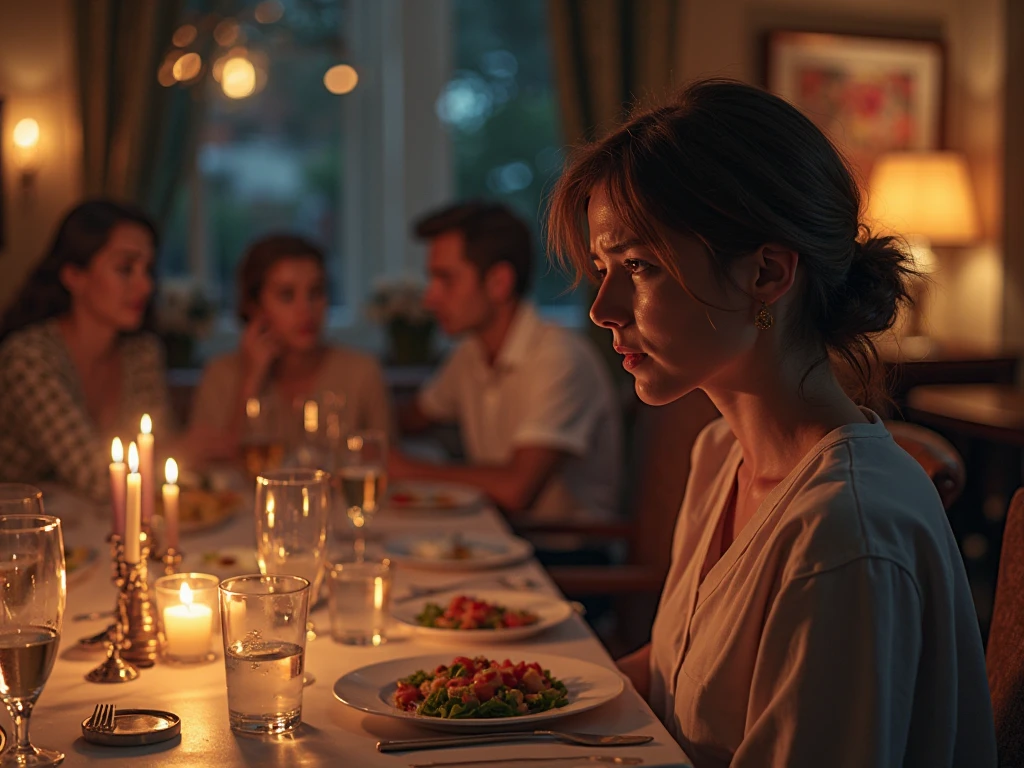
The silence from Matt was deafening, punctuated only by the occasional passive-aggressive “sensitive” jab from his mother. I replayed the scene endlessly: her smirk, his laughter, the crushing humiliation. My friends were divided; some applauded my defiance, others suggested I should have sucked it up for Matt’s sake. The weight of being deemed “overreactive” by the very people who had orchestrated my public embarrassment gnawed at me. I believed I was justified, but the isolation and self-doubt were immense.
A few days later, I received a call from Matt’s older sister, Chloe. Chloe was usually the family mediator, often trying to smooth things over, but she had been unusually quiet since the dinner.
“Hey,” she said, her voice unusually subdued. “I know things are rough. I just… I need to tell you something. About Mom. And about Matt.”
I braced myself, expecting her to scold me for leaving.
“You know Mom’s always been really focused on Matt,” Chloe began, her voice soft. “He was her only boy, born after two girls. And she almost lost him as a baby. He was very sick, spent weeks in the NICU. She was terrified. Absolutely terrified she was going to lose him, just like she almost lost him at birth.”
My breath hitched. I hadn’t known any of this.
“After that,” Chloe explained, “Mom became incredibly, profoundly anxious about anything that might ‘take’ Matt away from her. Not just physically, but emotionally. She smothered him, controlled every aspect of his life. She wanted him to be literally joined at her hip. She tried to dictate his friends, his hobbies, even his college choices. And she never truly let go of that fear of losing him, of him being ‘taken’ from her.”
“When Matt started dating you,” Chloe continued, her voice tinged with sadness, “Mom didn’t see you as a girlfriend. She saw you as a threat. As something that was ‘taking’ Matt away from her, just like she’d always feared. Every moment he spent with you, every decision he made that wasn’t solely about her, triggered that deep, primal fear of abandonment from when he was a baby. Her ‘jokes,’ her passive-aggressive comments, her need to sit between you two… it wasn’t about disliking you. It was a desperate, almost involuntary, attempt to physically insert herself into his life, to reclaim him, to assuage that overwhelming, unaddressed fear of losing him, a fear rooted in the trauma of his infancy.”
“And Matt,” Chloe said, her voice softening further, “he grew up with that. He’s been conditioned his entire life to ‘manage’ Mom’s anxiety. To laugh at her ‘jokes,’ to play along, to give her what she needs to keep her calm. He doesn’t even realize he’s doing it. When you left, he didn’t see your hurt; he saw his mother’s fear being triggered, and his immediate, ingrained response was to try and ‘fix’ it, to minimize it, to blame you for ‘overreacting’ because that’s what he’s always had to do to keep his mother from spiraling. He’s not malicious, Frey. He’s trapped in a lifelong pattern of managing his mother’s unhealed trauma.”
The world tilted. The “possessive” mother-in-law, the “joke,” Matt’s “overreaction” – it wasn’t about malice or disrespect for me. It was the devastating legacy of unprocessed parental trauma. Matt’s mother wasn’t just a controlling figure; she was a woman haunted by the specter of losing her child, a fear so profound that it manifested as a desperate, almost subconscious, attempt to control every aspect of his life. Matt’s complicity wasn’t about indifference; it was a deeply ingrained, almost involuntary, mechanism to manage his mother’s anxiety, a role he’d played since childhood. My dignified exit wasn’t just justified; it had, unknowingly, shattered a fragile, deeply entrenched family dynamic built on unaddressed fear. The AITA question, once a clear binary of right and wrong, dissolved into a profound, aching understanding of the unseen burdens people carry, and how the echoes of deeply entrenched, unacknowledged family trauma can tragically dictate adult actions, even at the cost of profound love and enduring relationships.