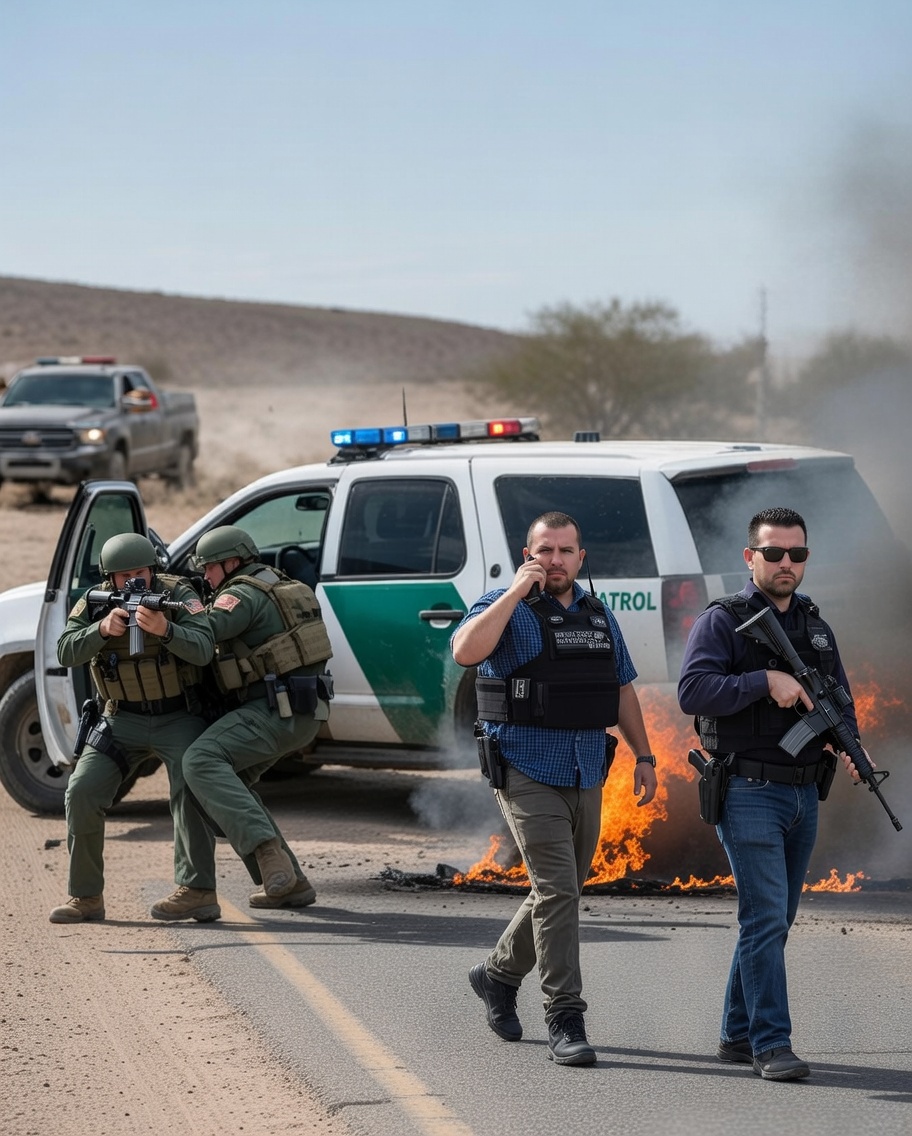
The Ambush
Border Patrol agents were patrolling a remote stretch near the U.S.-Mexico line when gunfire erupted. Bullets ricocheted off vehicles. Shouts rang through the desert. Men and women dived behind rocks and patrol trucks.
It was the Sinaloa Cartel. A squad of masked, heavily armed gunmen had coordinated the ambush perfectly. The agents had walked straight into a trap.
Within minutes, federal command authorized deployment of the Rapid Response Strike Force. Helicopters lifted off, tactical teams mobilized, and drones scanned the area from above.
Delaney realized this was more than a simple attack. The cartel had intelligence on patrol movements. They had mapped escape routes and choke points. Someone had leaked information.
The Standoff
The standoff lasted hours. Federal units advanced carefully, moving in shifts, using night-vision and thermal imaging to track movement through the rugged terrain. Cartel shooters vanished behind ridges, only to reappear in positions Delaney didn’t anticipate.
Inside the makeshift base the cartel had set up just across the border, radios crackled. A figure known only as El Arquitecto coordinated the operation. He wasn’t in the field, yet every movement, every attack seemed pre-planned down to the second.
For Delaney and his team, the desert had turned into a deadly chessboard. Every misstep could cost lives.
Uncovering the Network
When the firing finally subsided, the agents discovered hidden caches: weapons, high-tech surveillance devices, encrypted laptops, and documents. Among them were maps showing smuggling tunnels, safe houses in both countries, and schedules for shipments of weapons, drugs, and human cargo.
“This isn’t just an ambush,” Delaney muttered. “This is an operation designed to test our capabilities. To see what we know. And to plan the next move.”
Inside one of the laptops, they found messages hinting at collusion. Local officials. Border employees. Corrupt law enforcement. Someone inside had given the cartel information that made the ambush possible.
The First Plot Twist
Just as they prepared to secure the site, a drone feed revealed movement: someone familiar—Deputy Inspector Luis Vargas, a trusted contact for the Border Patrol—was speaking quietly to the cartel on the Mexican side. Delaney’s stomach sank.
“You’re kidding,” he whispered.
Vargas had been providing intel. Perhaps for money, perhaps for fear, or maybe for reasons no one yet understood. Delaney now faced a brutal reality: the cartel had insiders at multiple levels, making it nearly impossible to trust anyone.
The Chase
Over the next days, federal agents traced the cartel’s movements deeper into Arizona and New Mexico. Delaney led a small team to a remote safe house. But the moment they approached, explosives detonated in the distance. A diversion.
Then the strike force received a tip: a shipment of drugs and weapons was being moved through a seemingly abandoned ranch in southern Arizona. Delaney knew it was a trap—but the opportunity to gather evidence was too valuable to pass up.
Inside the ranch, they found evidence that tied the cartel to several local politicians, shell companies, and even cross-border financial accounts. It was a map of corruption that stretched farther than Delaney had imagined.
The Personal Threat
Then the personal threats began. Delaney received messages at home, cryptic and chilling:
“Step back, or the next ambush will be at your doorstep.”
His family was suddenly at risk. Every call, every email, every movement he made was potentially being watched.
The Second Plot Twist
The team discovered a hidden tunnel running from the ranch into Mexico. Surveillance footage showed that some Border Patrol officers had been secretly meeting cartel members in the tunnels. This was not a single betrayal—it was a network of insiders aiding El Arquitecto.
Delaney realized that Operation Desert Storm had become more than just a fight against armed criminals—it was a war against a shadow network infiltrating law enforcement, politics, and business.
The Open Ending
As Delaney planned the next move, intelligence came in: a massive shipment was about to cross the border at a new, unknown location. The cartel knew they were being pursued. And the final message hit him like a punch:
“Phase Two begins when you least expect it. Your allies may be your enemies.”
The sun set over the desert. The wind carried the faint scent of gunpowder and dust. Delaney knew this was only the beginning. The cartel had tested them. They had adapted. And somewhere, El Arquitecto was watching, planning, waiting.
The next confrontation would decide more than arrests. It could decide the fate of communities, law enforcement, and perhaps even the country.
Operation Desert Storm was far from over.