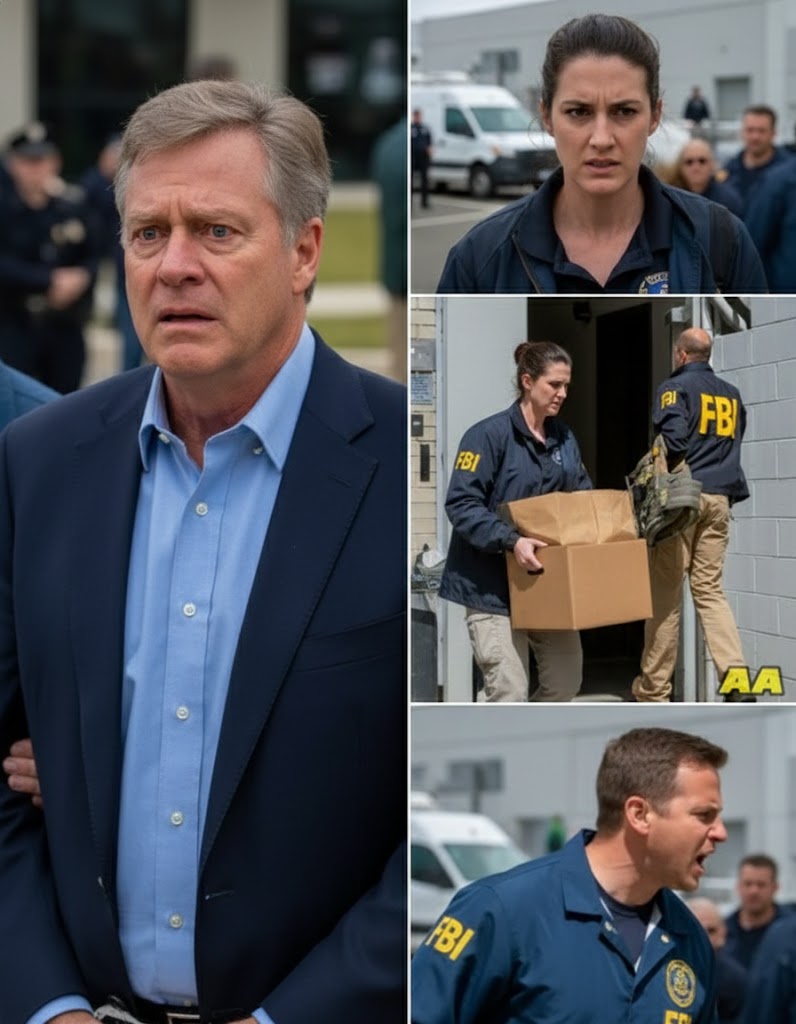
The Packages That Never Should Have Arrived
It started with a pattern no one wanted to notice.
00:00
00:00
01:31
Special Agent Daniel Mercer had been assigned to the Cyber and Financial Crimes Division for nearly a decade. He’d seen fraud, Ponzi schemes, and insider trading. But nothing in his career prepared him for what he stumbled upon at the Amazon warehouse network.
It wasn’t the volume of shipments. That was expected.
It was the discrepancies.
Boxes scanned and routed in ways the software said were impossible. Packages leaving one facility and appearing at another hundreds of miles away within hours. Inventory logs that contradicted physical counts.
At first, it looked like human error.
But Mercer noticed something else: the anomalies followed a pattern.
A pattern so precise it seemed orchestrated.

1. The First Clues
Mercer began quietly digging, cross-referencing warehouse scan logs with GPS data from delivery trucks.
He noticed certain boxes labeled as electronics or household goods never reached their destinations, or were marked “delivered” but with no confirmation from customers.
He asked a warehouse supervisor.
“Sometimes scanners fail,” she shrugged. “It happens.”
But Mercer didn’t believe her. Not anymore.
The missing shipments weren’t random. They were consistent.
And the scale was staggering.
2. The Tip
It was a single anonymous email that changed everything.
“Look at fulfillment lines 7 and 9 at night. Some boxes move differently. Not everything goes where it should. – A friend”
Mercer knew it was risky. No names. No contacts. Just a warning.
He began conducting night surveillance at warehouses in Chicago, Dallas, and Atlanta.
What he saw defied logic.
Forklifts moved pallets not according to the software, but according to hand signals from unknown supervisors. Packages were diverted, scanned, and rerouted to areas labeled “maintenance” or “returns.”
When questioned, staff claimed they were following protocol.
Mercer realized: protocol had been rewritten.
3. The Human Element
Mercer needed a human lead.
He met Angela Reyes, a veteran warehouse associate who had noticed the irregularities.
“I don’t know what’s happening,” she said. “I just know the numbers don’t make sense. And some boxes… they’re never scanned properly.”
Angela had seen employees being coerced or bribed to bypass scanning systems. Some refused. Some went along quietly.
Mercer began piecing together a network that extended beyond warehouses.
4. The Scope Emerges
Combining shipment logs, GPS data, and insider accounts, Mercer realized the magnitude.
Cartels weren’t simply shipping drugs via fake parcels.
They were using Amazon’s logistics infrastructure as a distribution highway.
Packages were broken into micro-quantities, hidden among legitimate items, and moved across state lines undetected. Cash and cryptocurrency were allegedly funneled through vendor accounts and payroll systems to avoid traceability.
The network was industrial-scale, operating under the guise of a legitimate business.
5. First Twist – The Inside Man
Mercer discovered that certain employees had inside access to sorting software and database permissions.
Not just warehouse staff—mid-level IT managers were allegedly complicit.
Some coerced.
Some bribed.
Some possibly involved voluntarily.
Mercer realized the operation was smarter than the FBI anticipated.
This wasn’t street-level smuggling—it was a corporate-level exploitation of a multi-billion-dollar logistics system.
6. The FBI Moves
After weeks of internal investigation, Mercer presented his findings to the federal task force.
Simultaneous raids were planned across multiple states.
Amazon warehouses, vendor offices, and distribution hubs were targeted.
News outlets reported:
“FBI Raids Amazon Warehouse Network — $3.4 Billion Cartel Shipment Network Disrupted”
But Mercer sensed something off.
The raids were executed flawlessly, but evidence suggested the top operators were never there.
Only facilitators—workers, supervisors, low-level IT—were apprehended.
7. The Second Twist
A month after the raids, Mercer received a secure package at his home.
Inside: a standard shipping label.
It listed a warehouse that had already been raided and sealed.
Attached was a USB drive labeled:
“Check the fulfillment line that never ends.”
Mercer plugged it in.
Inside was a tracking algorithm showing packages moving across multiple warehouses in a loop. Packages that should have been confiscated had vanished into new routes.
The network wasn’t dismantled.
It had adapted.
8. The Human Threat
Mercer learned that whistleblowers like Angela Reyes were being relocated under protective custody.
Some employees who refused to cooperate received threats or mysterious “accidents.”
Mercer began noticing shadowy figures around his apartment.
Strange cars parked outside.
Packages left at his door with no return address.
The network was watching.
And it had learned how to survive exposure.
9. The Scale
The more Mercer dug, the more he realized the operation had far-reaching tentacles:
-
Warehouses in multiple states.
-
Vendor contractors tied to third-party delivery systems.
-
Payroll and HR systems used to launder funds.
-
Freight companies partially compromised.
It wasn’t a single cartel or warehouse—it was a replicated model, scalable and resilient.
10. The Chilling Discovery
Mercer discovered that military and federal supply chains were also potentially vulnerable.
The logistics system used by cartels overlapped with government contracts in certain regions.
Not intentionally compromised… yet.
But if the model was replicated, the consequences could be catastrophic.
11. Open Ending – Setup for Part 2
Mercer received a final message:
“You’ve exposed one path. Thousands more remain. The packages never stop moving.”
He stared at the tracking system on his laptop.
Boxes, trucks, routes, loops—endless.
And somewhere, a new shipment was already underway, headed to destinations Mercer had never imagined.
The network had survived. Adapted. Evolved.
He realized that the investigation had only scratched the surface.
And the next chapter would be far deadlier, stretching across states, corporations, and borders.