Hello everyone, I’m **Silus**, 25 years old. Right now, I live alone behind a scrapyard, one of the biggest in Texas. My life these days is pretty simple. I wake up early and spend most of my day working, surrounded by the sound of forklifts, the smell of motor oil, and stacks of metal crates. I usually get home late, grab a quick bite, and go to bed early. No one checks in on me or meddles in my business. Everything moves along like a routine that needs no explanation. Before I turned 15, I had a family. It wasn’t exactly a happy one, but it was all I had to hold on to back then. I grew up in a small house in the suburbs where I believed I’d be allowed to stay as long as I behaved. Life felt stable. At least I thought it did until that night on Father’s Day when everything inside me came crashing down. It all started with something my little sister said. Just a few words, but they were enough to wipe out everything I once believed was safe. And from that night on, I began to understand that some doors, once shut, never open the same way again.
—
The Incident and Its Immediate Aftermath
To help you understand my story better, let me take you back to everything that happened 2 months before Father’s Day. That day, my little sister **Arya** got hurt while I was taking her fishing. It was the first Sunday of April, and she’d been begging me non-stop until I finally gave in. The weather was calm that day. I took her out early in the morning, biking there. As soon as we arrived, I bent down to set up the bait. And when I looked back, she was gone. At first, I thought she was playing hide-and-seek. So, I called out a few times. No answer. That’s when the panic kicked in. I ran around yelling her name, heart pounding, voice going. By the time my legs could barely hold me up, I called the police. They found Arya over an hour later. She had injuries on her shoulder and hip, deep scratches that the doctors said could have been caused by some animal. When she was rushed into the hospital, still in shock, she said just one thing: “Silus left me alone.” I don’t know if those words came from fear or something else, but they were enough to tear down everything I’d tried to protect. After that day, Arya’s health took a turn. She was in pain, irritable, and couldn’t sleep. Our home, already quiet before, grew even heavier. **Lillian**, my stepmother, started acting more distant, and my father, **Daryl**, didn’t say a single word to me after that.
—
Father’s Day: The Ultimate Rejection
Then came Father’s Day two months later. The four of us sat around the old kitchen table having dinner at home. No celebration, no guests, just the usual dishes lay on the worn wooden table under the yellow light that had faded with time. And a silence lasted from the moment we sat down until the meal ended. No one brought up the past that evening, but the silence between us was so thick it felt like living inside a glass room with cracks spreading slowly, and no one could tell when it would shatter. After my stepmother and Arya gave their gifts, and my dad smiled with joy, I stood there watching like an outsider in a life that used to be mine. Still, like them, I waited for the moment he’d accept my gift. Something personal I thought might mean something. It was a necklace he gave me on my 11th birthday, the last gift he ever gave before my mom died. I’d polished it and placed it in a box with a handwritten letter. In it, I repeated something he once said to me when I was little: “Whenever you feel lost, give this to me. I’ll understand.”
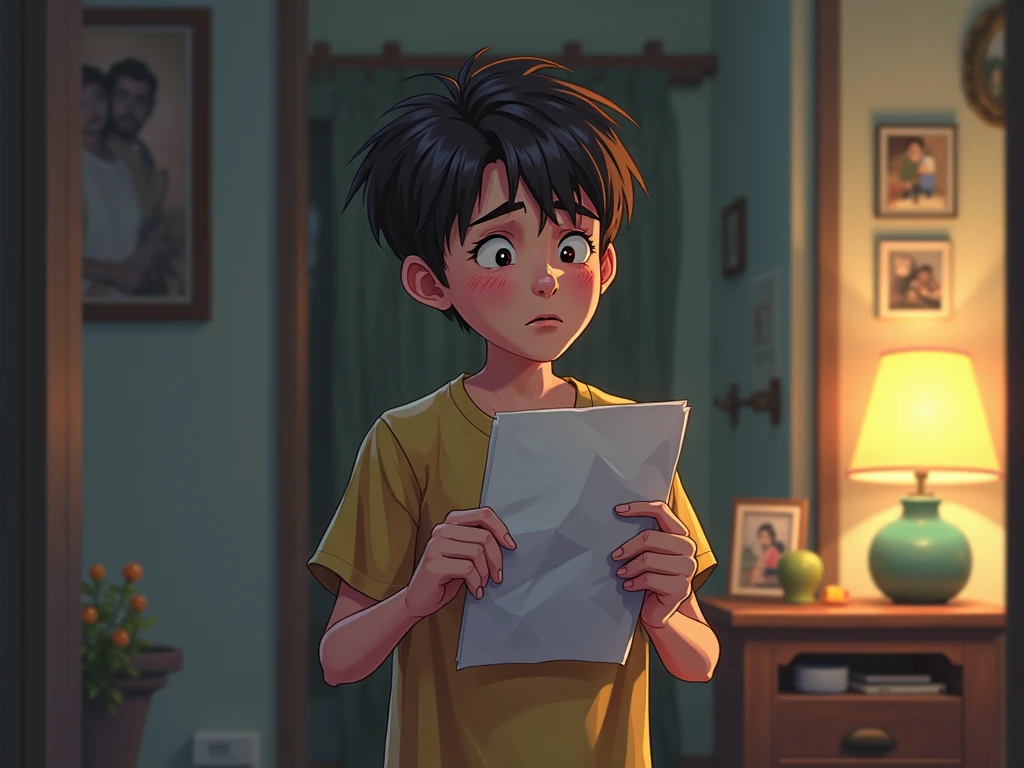
I stepped forward just as my stepmother finished giving her gift. And then suddenly, my dad looked at me and said in a calm, rehearsed voice, like everything had already been decided, “Go to the living room. I have a special gift for you.” At that moment, I truly believed he had saved something for me, something just for us. I thought maybe after everything, he still had something left to say, even if it was small. When I walked into the living room, **Mr. Carlson**, our longtime family lawyer, was already sitting on the couch. He’d arrived an hour earlier, but hadn’t joined us for dinner. On the table was a large open envelope. He looked at me, eyes filled with sympathy, and said softly, “Silus, I’m just here as a witness. All the paperwork for the custody termination has been prepared.” I turned around when he said it. My father stood in the doorway, not looking away. His voice was steady, low, and firm: “Because you put your sister in danger. Starting today, you’re no longer part of this family.” The words hit like a stone to the chest. I took half a step back. My lips trembled as I forced out the only question I could manage: “Is this because of the fishing trip?” Even as I asked, I knew I didn’t need an answer. I swallowed hard and stepped forward again, trying to steady myself. Then, pulling together whatever courage I had left, I said, voice shaking, “I’m sorry. I didn’t mean to. I never wanted to hurt her.” After that, I said everything I could. I told him I wouldn’t go near Arya again if that’s what he needed. I admitted I was careless. I took the blame, but I told him I never meant to cause harm. I begged for a chance, even the smallest one. But after all the pleading, he stayed silent. A moment later, he turned to Lillian and said, “Bring down his suitcase.” My stepmother said nothing. She walked upstairs, then came back down carrying my old gray suitcase. My dad walked to the front door, opened it, and threw the suitcase onto the lawn. I was pushed out the door just seconds later. The gift box in my hands flew out with me. The lid popped open. The necklace spilled out, skidding across the porch tiles until it stopped. I hit the steps hard. My arm took the brunt of the fall and my knees scraped. My hand brushed against the necklace. And in that moment, memories came rushing back: of my mom, of my dad’s promises, and of the look in my own eyes, back when I still believed he’d keep them. I forced myself to stand, reached down to gather whatever was left of mine. Then I looked up at him and asked, voice choked, “Why do you always take her side? She’s not even your real daughter.” With that same even tone, not a flicker of emotion, he replied, “She is my real daughter. And you? You’re nothing anymore.” That wasn’t just a declaration. It was an ending. I felt a door slam shut inside me, sealing away everything I once believed was true. I used to live with him and with my birth mother until she passed away when I was 12. 3 months after her funeral, he brought home a woman named Lillian and a 7-year-old girl named Arya. There were no explanations. I was just expected to accept it. But after Daryl’s confession, I finally understood. Arya was the result of an affair that had started before my mom died. Lillian didn’t come to replace my mother. She already had a place in my father’s heart long before. From the day she moved in, Lillian always acted gently around him. But behind his back, she barely spoke to me. Slowly, I started to feel like an extra piece in their picture-perfect family. And Arya, even as a child, knew exactly where she stood. A glance at the right moment, a well-timed sentence, and I’d be pushed aside without anyone needing to say it aloud.
—
Life on the Margins
After the door slammed shut behind me, I sat on the porch steps for a long time. I wasn’t waiting for it to open again. I just needed to be sure there was nothing left to return to. Pulling my suitcase through the gate, I heard a soft voice call out behind me. It was **Mrs. Velma**, the elderly neighbor who lived next door. She came closer after watching everything unfold, her eyes fixed on me like she was seeing something she couldn’t fix. She pressed a small wad of cash into my hand and whispered, “Don’t die, okay? I can’t afford to take you in, but come find me if things get too hard.” Right after, her daughter showed up, seeing her mother standing beside me, she gently tugged her arm and said loud enough for both of us to hear, “Stop getting involved with that family. Come inside, Mom.” Mrs. Velma didn’t say another word. Her daughter led her back in and the door closed behind them, quiet like a sad punctuation mark. I stood by the gate for a few more seconds. The cash still sat in my hand. And that very money led me to a place completely unfamiliar. That night, I didn’t know where I was going. But I knew one thing for sure. Whatever came next wasn’t starting from that doorstep anymore. I left that familiar neighborhood the same night, carrying nothing but an old suitcase, a custody termination letter, a necklace in my pocket, and a handful of dollars Mrs. Velma had pressed into my hand. The last trace of kindness that hadn’t closed its door yet. I didn’t know where I was going. I just knew I had to get as far away from that place as possible. The rows of suburban houses faded behind me like a chapter cut clean from my memory.
The next morning, I stood still in front of a small bus station at the edge of town. I scanned the faded route map line by line, looking for a familiar name. The city where my grandmother used to live when I was little. I didn’t remember the exact address. It was somewhere farther east with an old tiled roof and an orange grove in the backyard. I spent almost all my money on a ticket and boarded the first bus, clinging to the fragile hope that if I made it there, she might open her arms like she used to when I ran away from school as a kid. But I was wrong. I got off at the wrong stop. The town I arrived in had no orange trees, old tiled roofs, and no one waiting for me. I walked around for a while and asked a few elderly folks on the sidewalk, but no one recognized the name I gave. That afternoon, I sat on the steps of an old bakery that had long been closed, watching the sun sink past the train tracks, unsure whether I should keep moving or try to turn back. Not that there was anything to go back to. That night, I slept behind a warehouse, and all I could think was, “If I couldn’t even find my way back to a place I once called home, how was I supposed to believe in anything else?” The next day, I made it to another town, one with a youth center I’d overheard someone mention while I wandered through the streets. I waited in line, surrounded by other kids, some with dirt on their faces, clutching worn backpacks, others with nothing. When it was my turn, I explained everything to the staff member, that my biological father had kicked me out, that I had no guardian and nowhere to stay. She looked at me, flipping through some forms. Then she asked if I had any official complaint, any abuse report, or a statement from local authorities. I shook my head. After a few minutes of reviewing my case, she said that because I was a biological child and there was no documented abuse, the center couldn’t take me in. If I were truly in danger, she told me I’d have to go back to my hometown to file a report and wait for the system to process it. I left that place in silence. For the first time, I felt like I no longer existed in any system. No school was waiting for me. No organization had an open door. And worst of all, no one stood beside me to say I was worth keeping. The days that followed passed like scenes from a slow, silent film with me wandering through each frame, detached. I slept on park benches, then under bridges when the rain came. Some nights I managed to get leftover food from a fast food joint. Other nights I drank from fire hydrants and waited for morning. My clothes dried on me after the rain. After a while, my shoes started to fall apart, but I kept the necklace in my pocket. The thread tying me to a past I didn’t know whether to grieve or resent. One night, I had a high fever after being in the cold for too long. My body burned, my head throbbed, and every joint felt like it was on fire. I dragged myself to a roadside gas station, collapsed beside a dumpster, and sat there soaked in sweat like I’d run for miles. No one stopped. I fought to keep my eyes open, but I couldn’t. When I came to, I was lying on a piece of cardboard, covered with a heavy coat. Next to me sat a man with a long beard, messy hair, a thin face, but eyes that somehow looked wide awake. He held an open bottle of water in one hand. When he saw me move, he said in a raspy, cold, cracked voice, “You’re awake. You had a hell of a fever. Thought you were gone.” After those words from the stranger who had saved my life, I gave a weak nod, then closed my eyes again, too tired to speak. I didn’t know his name at the time. But a few days later, I started calling him **Roy**.
—
Building a New Foundation
I lived with Roy for nearly a month behind an abandoned warehouse about 3 miles from downtown El Paso. It was a narrow patch of land backed up against a row of rusted containers with a tarp and a few wooden planks rigged into a makeshift shelter. Roy called it the “forgotten corner,” a place nobody looked at, where no one cared who lived or died. During the first few days, I barely spoke. I curled up in a corner and barely moved all day. At night, I drifted in and out of sleep, haunted by the image of my father’s eyes and that door slamming shut like the final rejection. There were nights I’d jolt awake, heart pounding so hard it hurt, my back soaked in cold sweat. I never told anyone. I didn’t even know what I’d say. From the moment I arrived, Roy never asked me much. He’d wrap his old coat around his waist every morning, grab his cart, and head toward the industrial zone. By late afternoon, he’d returned with a plastic bag full of whatever he’d scavenged, sometimes food, usually scraps. He always ate silently, and his back turned to me as if he were long used to being alone. I’d sit there and watch, my stomach tightening with each bite he took. The hunger made me feel like I was fading, like if I leaned too far in one direction, I might disappear completely and no one would notice. After 3 days like that, I was barely holding on, starving and exhausted from restless dreams. On the fourth night, while Roy was sitting down stripping the plastic off a bundle of wires, I finally whispered almost to myself. “I don’t know what to do.” Roy didn’t look up, he said slowly. “If you can’t save yourself, nobody’s going to save you.” It wasn’t loud, but it hit like a hammer to the skull, ringing through everything I had left inside. I sat still for a few minutes watching him. He kept working, not caring whether I heard him, but I knew that sentence came from a life that had paid the price to say it. When he was lacing up to head out the next morning, I got up and followed him. No words were exchanged. He didn’t need to ask. We pushed the cart toward the old market district where dumpsters overflowed and abandoned auto shops left behind scrap piles. Roy started showing me everything: how to tell metals apart by weight, how to use a magnet to test them, how to separate aluminum from steel, and how to coil copper wire neatly. He taught me to melt off plastic casing with a lighter, break open a fridge shell to get to the motor, and bargain without getting ripped off. What others saw as trash, Roy saw as resources, and to me, it was the only chance I had left to survive.
3 weeks later, I knew his whole route. We had a pickup schedule for every block and knew when each business tossed their waste. Sometimes we’d haul in old fridges, busted fans, even construction wires. We avoided territories already claimed by other groups, though that wasn’t always possible. By then, I no longer worried about hunger, but my thoughts still spun endlessly around my family. Once I slipped away from Roy and stopped by an old internet cafe. I logged into my old account and searched for my stepmother’s Facebook page. What I saw crushed me completely. There she was posting vacation photos, the three of them smiling like nothing had ever gone wrong. I saw my father’s face, smiling as he used to when my real mom was still alive. After Lillian moved in, I rarely saw that smile again. And now somehow it had returned only after I had vanished from his life. That day, I silently accepted what I had refused to believe: I was something he’d always wanted to throw away. All he needed was an excuse. And from that moment on, I promised myself I would never, ever go back to that house. Not even once. The days that followed, I just kept working alongside Roy. It became my way of forgetting, of numbing the pain I carried. Even though I knew deep down life was never going to stop testing me. One afternoon in mid-June, two strange men showed up while I was crouched behind an HVAC shop picking up stray cable. One of them yanked my shirt from behind and without a word, the other slammed a metal pipe straight into my back. I collapsed onto the curb trying to crawl up only to be kicked again hard in the ribs. I don’t remember what they said. Just blood dripping down to my lips, dust blowing into my eyes, everything going blurry before the pain took over and I blacked out. Roy found me more than half an hour later. He dragged me back to our shelter and cleaned the blood off with a rag soaked in water from scavenged bottles. That night, amid pain, my mind drifted back to my family’s old kitchen. To the smell of grilled meat on Sunday nights and the soft humming of my mom in the bathroom when she was still alive. I remembered the promise my dad made her as she lay dying: “I’ll take care of the boy. I promise.” And from that memory, a quiet anger lodged in my chest. Not loud, not rising, but unshakably there. Whenever someone mentioned **Fresno**, the place I grew up, it felt like getting stabbed again. That name still haunted my sleepless nights. Once a symbol of home, now a place I’d never be allowed to return to.
—
Forging My Own Path
That first year passed in silence and struggle. Roy started coughing more and walking slower. I took him to a charity clinic. All they gave him was cough syrup and advice to rest. Not long after, on a cold morning, I woke up and he was gone. I searched around the warehouse and finally found him curled up under the tarp behind our cart, his body cold and still. I sat beside him for hours. Later, I called the nearest health center. They came with a refrigerated van. No sirens, no farewell. A few days later, I was told he’d be buried in the city’s unclaimed section. A small plot, no headstone, just a wooden stake with a number. I stood there alone, watching the man who once saved my life lowered into the ground with no one else present but me and a quiet worker holding a shovel. From then on, I knew I no longer had the luxury of choice. Either I pulled myself up or I’d end up just like Roy, buried in a nameless lot no one would ever visit. After Roy died when I was 17, I took the same push cart he left behind and kept walking his route for almost a year. I learned how to talk to scrapyard owners and negotiated regular drop-offs. I opened a bank account using an old social security card I still had in my wallet. I signed a supply contract with a recycling depot outside the city. Some days they’d turn me away. Some days they underpaid, but I never missed a delivery. Two years later, I saved up enough to buy a sturdier cart. I rented a small roadside lot to use as a collection point. Every week, I gathered, weighed, logged, and reinvested—a self-taught system no one had shown me. At 20, I bought a used truck, hired a mechanic to fix it, and painted a logo on the side: **Silent Reclaim**. I registered a business ID, filed taxes, and hired three people who’d once lived on the margins like me to cover different routes. Once the company was official, I leased a larger lot on the edge of El Paso, a former truck stop. I built a warehouse out of steel beams and leftover sheet metal from abandoned sites. On windy nights, the roof would rattle like distant sighs. I lived in a narrow room in the back, slept on a folding bed, and cooked on a gas stove propped against the wall. I woke before sunrise every morning, mapped routes, and made timely deliveries. When it rained, I wore a torn poncho, and waited through puddles to collect soaked copper wire. When the sun blazed, I came back smelling like scorched iron. The company was called Silent Reclaim. I painted the name by hand on a wooden sign out front, a reminder: I live quietly, picking up what was once discarded and turning it into something of value. The monthly profits were enough to keep things running. Some months I had a few hundred left over. Other times I had to dip into reserves. I still ate instant noodles at night, wore the same old hat each morning, and used the worn-down shoes Roy left behind. But at least I wasn’t sitting on a curb waiting for someone to toss me a coin. My life at that point was stable. But every time I looked at the necklace in my wallet or opened the old folded letter with faded creases, I felt myself standing at the edge of an old memory. A place that once was home, then vanished in a blink before I could turn around. In the six years since the day I was thrown out, I stumbled more than once. There were moments I wanted to give up altogether. On stormy nights, I’d stand alone in the warehouse, watching my shadow ripple across the warped sheet metal wall and wonder if I was really living or just dragging out something that had ended long ago. I went from being a kid with a mom and a dad to someone no one was waiting for. I survived on work that most people turn away from. Some looked at me with pity. Others like I were a stain on society. But to me, the job Roy left behind was the most honorable thing I’ve ever had. Without him, without that worn-out cart, the smell of sweat and motor oil soaked into torn gloves, I probably would have died somewhere in a quiet alley on a forgotten bench. And no one would have even remembered my name.
—
Unveiling the Truth
One afternoon in mid-October, I heard someone call my name while I was parked at a gas station near the New Mexico border. The voice was shaky, faint, and filled with disbelief. I turned around and I couldn’t believe what I saw for a few seconds. It was Mrs. Velma, the woman who once pressed her last few dollars into my hand before her daughter pulled her away. After all those years, she looked thinner. Her hair had turned almost entirely white. She was holding a small gift bag like she’d just gotten off a long trip. She stared at me for a long time, then stepped forward and wrapped her arms around me without saying a word. A moment later, her voice trembling with emotion, she whispered in my ear, “I thought about calling the police, but I was afraid they’d treat you even worse than the people in that house did.” When she embraced me, I stood frozen, letting my tears fall onto the frayed shoulder of my old work shirt. Then I whispered back, “You already did more than anyone else ever did.” After a short conversation, one of her relatives came to pick her up. Before leaving, she turned back and asked, “Can you give me an address? I want to send you something for Thanksgiving.” First, I was going to say no. The fear was still there. The fear of opening up and letting someone into a life I had struggled to rebuild. But then I looked at her, the one person who had stepped toward me that night and handed me her last bit of money, not out of pity, but out of genuine compassion, and I couldn’t turn her down. On the way back to El Paso, I drove slower than usual. With every mile that passed, my chest felt hollow. In just a few brief moments, Mrs. Velma had told me everything after the night I was thrown out, just enough to piece together all the things I never understood, the ones I never dared to ask. During her senior year of high school, Arya once saw me on a field trip. I pushed my cart through a park nearly 80 miles from our old house. She stood there a long time, afraid to call my name and scared to come closer. When she got home, she told my stepmother. But instead of encouraging her to tell the truth, the woman coldly warned her that if she ever opened her mouth, my father would throw her out just like he did me. And Arya, haunted by the memory of how he cast me out, chose silence. She kept going to school and living in that house. But many nights she couldn’t sleep. She’d get fevers, haunted by dreams of me standing at the front door, soaking wet, saying nothing, and then vanishing. At 21, Arya was diagnosed with chronic kidney failure. That was when, as the doctors requested family medical history and potential donors, she finally told my father everything. How she’d hidden on purpose during the fishing trip to pull his attention entirely to herself. My father sat in silence for a long time after her confession. After that, he started drinking heavily, stopped going to work, and spent his days in the garage watching TV with the volume off. Anytime someone mentioned my name, he’d lower his head and say nothing. A few months after Arya’s diagnosis, they sold the house to pay off debts and cover her medical bills, but insurance didn’t cover enough, and the transplant list was hopelessly long. Since then, burdened by guilt, Arya had been trying to find me since she glimpsed me when she was 18. She searched my name online and reached out to old acquaintances, but she never saw anything solid. Her search lasted almost 3 years. Quiet, unnoticed by everyone except Lillian. After seeing Mrs. Velma again, my thoughts were a blur. I didn’t know whether to feel angry or relieved. Maybe it was both. Perhaps it was neither. All I knew for sure was this: The door my father closed that day for me would never open again.
—
The Final Confrontation and Peace
I’m no longer the homeless kid shivering under a freezing awning. I have a place to live, a job that pays enough to get by, and a savings account that while not large, gives me peace of mind every time I check it. I have a team of brothers at work. People like me came up from the margins. We don’t need promises or big words. Just being there each morning, sharing the trucks, the scrap wire, and the midday meals under the blazing sun. That’s enough. What we have now is part effort, luck, and the rest: deep enough scars to keep us from returning to where it all began. I don’t go hungry anymore. I have clothes that fit, but there’s still a hollow space inside me. Not from poverty, but from a place I once called home. A place that erased me in a single night. A few months after Thanksgiving, while I was reviewing delivery logs before a shipment, someone unexpectedly showed up at the yard. And to my shock, it was my stepmother, Lillian. I froze for a moment, unable to believe what I was seeing. Then I turned around, ready to head back inside. But behind me, I heard a voice I hadn’t heard in years. Soft, trembling, familiar. “Silus.” That single word made me pause. Just one name pulled me back to those early days when she first moved into our house. Her voice was soft, then, seemingly gentle, filled with what felt like affection. And from that softness, my life had slowly been suffocated. I turned around. She looked pale with watery eyes. Lillian stepped closer. Her voice choked with tears. “I’m sorry. I should have stopped him. I should have kept you.” I didn’t answer. I just stood there, letting her play out what felt like the final act of a performance long overdue. She went on crying harder, voice cracking. She said the house had felt empty after I left, that my father had fallen apart, that Arya couldn’t focus in school without her brother, and that she had spent countless nights haunted by the image of my 15-year-old face the night I was cast out. I didn’t move. Every word was perfectly timed, every emotion carefully measured, like lines she’d rehearsed. And then, finally, the real reason she came spilled out, voice trembling with the weight of desperation. “Your sister is dying. We’ve tried everything. We can’t afford the treatment. You have money. Please help her.” The moment those words landed, something hollow tightened in my chest. I stood there for a few seconds trying to understand everything. Then I let out a short laugh, not of joy or bitterness, just a reflex. The kind of laugh that comes when you realize the truth has always been a cruel little joke. When I met her eyes, filled with hope and pleading, I spoke slowly and clearly. “You’re not here for me. You’re here for your daughter, for money.” Each word landed in the silence between us like stones dropped into still water. Cold, unshakable. Her shoulders trembled at my response. And with that, I said my final words. “Too late. Get out.” Then I climbed into my truck and drove off. In the rearview mirror, I could still see her standing there, silent, like a shadow stepping out of a past I would never look back on again. Many nights after the encounter with Lillian, I couldn’t sleep. During the day, I kept working, meeting clients, handling inventory, keeping things running, but I disappeared into a nameless darkness once the lights went off in the warehouse. The questions started spinning, not about Arya, but about myself. Had I moved on? Had I truly broken free? Then one night, a few days later, I opened the desk drawer and found the Thanksgiving card Mrs. Velma had sent. Inside, she had written her landline number and a short message: “Call me if you ever need to. I’ll be here.” She had always been like that, always trying to hold on to me in whatever way she could. Even though she wasn’t family by blood, she was like Roy, someone who kept the last pieces of my humanity from falling apart. I sat there a long time before dialing. The phone rang only twice before someone picked up. When she heard my voice, Mrs. Velma didn’t wait for me to speak. She just let out a soft sigh, paused a few seconds to steady her breath, and then began to tell me everything in a low and gentle tone. She couldn’t stop thinking about it after running into me at the gas station. A few weeks later, she visited the hospital where Arya was being treated. At first, she only planned to stand outside the room for a moment and leave. But when she got there, she saw Arya crying. No one else was in the room, just her, lying still between four lines and the soft hum of the dialysis machine. Mrs. Velma couldn’t hold back. She walked in, sat down by the bed, and held her. Then she told her everything from the night I was cast out to the years I’d spent scraping by. She told her about me curled up by dumpsters, about Roy, about the scrapyard, everything. Her voice grew heavy as she spoke, like the memory still hadn’t settled in her chest. She told me she never imagined Lillian would come looking for me. Never thought she’d have the nerve to show up. I stayed silent after that. Part of me wanted to be angry, but the other part understood: once they’ve seen too much, people can’t pretend anymore. The next afternoon, I drove to the hospital using Mrs. Velma’s address. From El Paso to my old city was nearly 800 miles. I left while it was dark, driving almost 13 hours without stopping. Some stretches of road were so long, I couldn’t even remember what I’d been thinking along the way. All I knew was that the closer I got, the heavier my chest felt, like a stone was lodged between my lungs. The hospital where Arya was being treated was a small facility tucked into an older neighborhood. I asked for her name at the front desk, then followed the directions down the main hallway. As I approached room 207, I saw her, thin and pale, but still Arya.