The lock on Zoey’s door, a stark line drawn in the sand, had ignited a war in my own home. Sammy’s furious accusations, my wife’s shaming, and the subsequent icy silence from everyone felt like a heavy blanket suffocating our family. I was protecting my daughter’s privacy and possessions, defending her right to boundaries, yet I was being painted as the unreasonable one, the one who implied kicking out family. But for me, it was never just about a makeup kit; it was about respect, about seeing my daughter’s distress, and the infuriating double standard. Was I truly the asshole for putting my foot down so decisively?
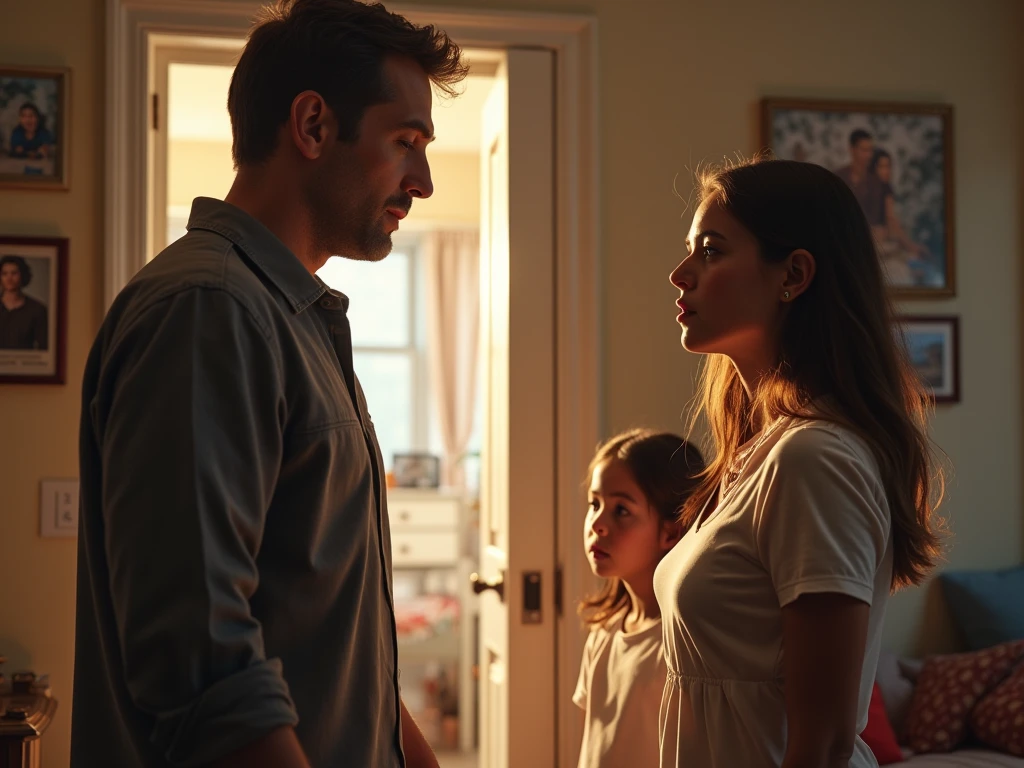
The silence in the house was a constant, suffocating presence. Zoey was quieter than usual, though I caught her occasionally giving me small, grateful smiles when she thought no one was looking. My wife barely spoke to me, communicating only through terse notes or exasperated sighs. Sammy and his daughters were like ghosts, moving through the house with an air of aggrieved indignation. I felt utterly isolated, convinced I was in the right, yet burdened by the heavy atmosphere.
Then, a few days later, I received an anonymous text message. It was from a number I didn’t recognize. The message was short, blunt: “Ask your wife about the red bird necklace.”
My brow furrowed in confusion. A red bird necklace? What did that have to do with anything? I dismissed it as a prank, or perhaps a wrong number. But the persistent, nagging feeling of something being amiss made me reconsider.
Later that evening, as my wife was about to head upstairs, I casually asked, “Hey, honey, do you remember that red bird necklace you used to wear all the time? The one Grandma gave you?”
My wife froze. Her back was to me, but I could see her shoulders stiffen. Slowly, she turned around, her face pale, her eyes wide with a mixture of shock and fear. “Why… why do you ask?” she stammered.
“Just curious,” I replied, trying to keep my voice even. “I haven’t seen it in years.”
She averted her gaze, fidgeting with her hands. “Oh, that old thing? I… I must have misplaced it. It’s probably in a box somewhere.” Her voice was strained, too casual.
The next day, while my wife was out, the mysterious text sender messaged me again: “Check Sammy’s room. Under his bed. The wooden box.”
My heart pounded. This felt too specific to be a random prank. With a growing sense of dread, I went to Sammy’s room. He was out, and his twin daughters were at school. I found a small, old wooden box tucked away under his bed. My hands trembled as I opened it.
Inside, nestled amongst some old letters and trinkets, lay the red bird necklace. But it wasn’t just the necklace. There were several other items: a small, tarnished silver locket that used to belong to my wife, a delicate hairpin I hadn’t seen in years, and even a small, hand-painted ceramic mug I’d bought for her on our first anniversary. They were all items that had, at some point, gone “missing” from our house over the years.
And then I saw it. Tucked beneath the jewelry, at the bottom of the box, was a small, crudely drawn picture. It was a crayon drawing of two girls, obviously younger, one with long hair (my wife as a child, perhaps) and the other with short hair (Sammy’s sister, a younger version of himself, but drawn as a girl). And the girl with the short hair was reaching out, grabbing something from the other girl. Below it, in childish handwriting, were the words: “MINE. NOT HERS.”
A sickening realization washed over me. Sammy’s daughters’ blatant disregard for Zoey’s belongings, their habit of “taking” things, their casual dismissal of her privacy – it wasn’t just “typical teenage girl behavior.” It was a learned behavior, a pattern deeply ingrained and implicitly sanctioned. My wife’s unwavering defense of their actions, her insistence that I was “overreacting” and should “treat them like daughters” – it wasn’t just about family loyalty. It was about her own past, a past intertwined with Sammy, a history of covert theft and ownership disputes that had been normalized within their family unit.
The red bird necklace, the silver locket, the anniversary mug – these weren’t just missing items. They were trophies, carefully guarded possessions of a childhood pattern. The “borrowing” wasn’t innocent; it was a continuation of a familial dynamic where boundaries were fluid and personal property was communal, especially when one person perceived a “right” to it. My wife’s “shame” at the lock wasn’t about public embarrassment; it was about the lock exposing a fundamental, deeply rooted dysfunction within her family’s perception of personal property and boundaries, a dysfunction that Sammy was now replicating with his own daughters.
The AITA question, once focused on my handling of the immediate conflict, dissolved, replaced by a chilling understanding. The fight over the makeup kit wasn’t a singular incident; it was a deeply ingrained, almost ritualistic re-enactment of a childhood dynamic that had quietly governed my wife’s family for decades. The lock wasn’t just about Zoey’s makeup; it was about me, unknowingly, challenging a pervasive, almost unconscious family pathology that had defined their relationships with personal property and boundaries for their entire lives. The silence, the tension, the blame – it was all a desperate attempt to maintain the illusion of “normalcy” within a family unit that had, for generations, blurred the lines of ownership and respect.